Leave Us a Message
Contact us now to get professional waste recycling solutions and quotation!
In PCB recycling, components like resistors, capacitors, and IC chips are held onto the board by solder. So going straight to mechanical dismantling just makes it harder. That’s why heating is such an important first step in PCB component dismantling.
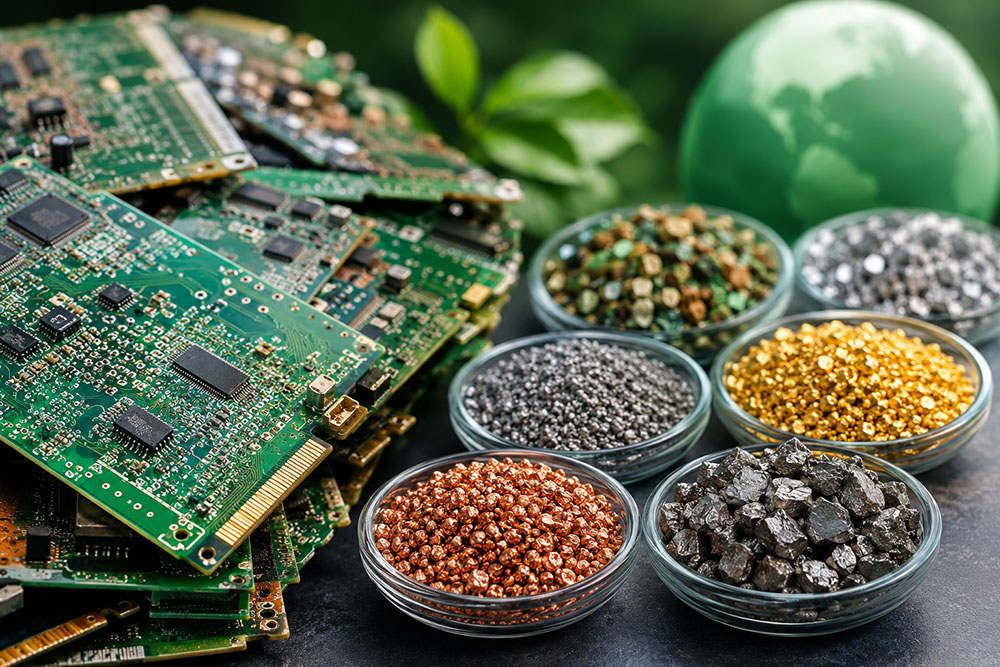
Heating softens the solder, which weakens the bond between the components and the PCB. That way, when the machine kicks in, the components pop off the board more easily — making your PCB dismantling machine a lot more efficient.
After appropriate heating:
Higher heating temperatures are not necessarily better; actual processing parameters must be adjusted based on the specific PCB and soldering materials.
Therefore, stable temperature control is a key factor to consider in electronic component recycling.
Industrial-scale PCB recycling typically does not rely solely on heating but rather combines heating with mechanical dismantling.
This approach is better suited for large-scale e-waste recycling.
Once the components are removed, the bare PCB moves on to crushing, screening, and separation — where you can recover the copper, aluminum, and other valuable materials inside.
So heating isn’t just part of the dismantling step. It’s a key pre-treatment stage in the whole PCB recycling process.
Gomine focuses on PCB recycling machines, PCB electronic components dismantling machines, and e-waste recycling equipment. We can put together a setup that fits your material, your capacity, and the output you’re after.