Leave Us a Message
Contact us now to get professional waste recycling solutions and quotation!


Discarded wine bottles are a common form of glass waste in daily life. Piling up large quantities of these bottles not only consumes space but also entails high transportation costs; furthermore, the glass can be further recycled after being crushed.
So, how does the GM-D350 single-shaft shredder process waste wine bottles, and what factors require attention during the process?
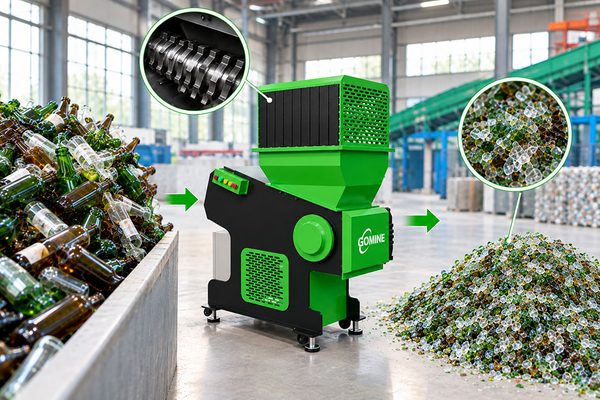
Discarded wine bottles are typically bulky and irregularly shaped, making direct transport and storage inconvenient.
Crushing offers the following benefits:
For waste glass items like wine and other glass bottles, preliminary crushing serves as a crucial step in the recycling process.
The GM-D350 utilizes a single-shaft shredding mechanism:
After entering through the feed inlet, waste liquor bottles are sheared and crushed into small glass fragments by the combined action of rotating and stationary blades, before being discharged from the outlet.
Actual performance depends primarily on the bottle size, glass thickness, feeding method, and discharge requirements.
Crushed glass is not merely “waste”; following further sorting and processing, it can be channeled into various recycling and reuse applications.
Common uses include:
If there are stricter requirements regarding particle size or purity, additional equipment for fine grinding, screening, or sorting can be integrated after the initial shredding stage.
Glass is characterized by high hardness and the tendency to shatter into sharp fragments; therefore, safety regarding equipment and operations must be prioritized when processing waste wine bottles.
First, avoid feeding large quantities of material at once.
Maintaining a steady feed rate helps ensure the equipment operates smoothly.
Second, inspect the material beforehand.
If the bottles contain significant amounts of foreign objects—such as metal or stones—these should be sorted out prior to processing.
Additionally, the cutting tools require regular inspection.
Tool wear directly affects crushing efficiency, so timely maintenance is essential to keep the equipment in proper working order.
The GM-D350 single shaft shredder is capable of shredding materials based on their specific characteristics, preparing the feedstock for subsequent screening, sorting, and resource recovery. If you are looking for solid waste shredding equipment, Gomine offers suitable solutions.