Leave Us a Message
Contact us now to get professional waste recycling solutions and quotation!


In the context of scrap cable recycling, a copper wire granulator shreds waste cables and separates the copper granules from the plastic.
So, how should you choose the capacity of a copper wire granulator? The key is to consider your specific raw materials, processing requirements, and budget—rather than simply chasing after large-scale equipment.
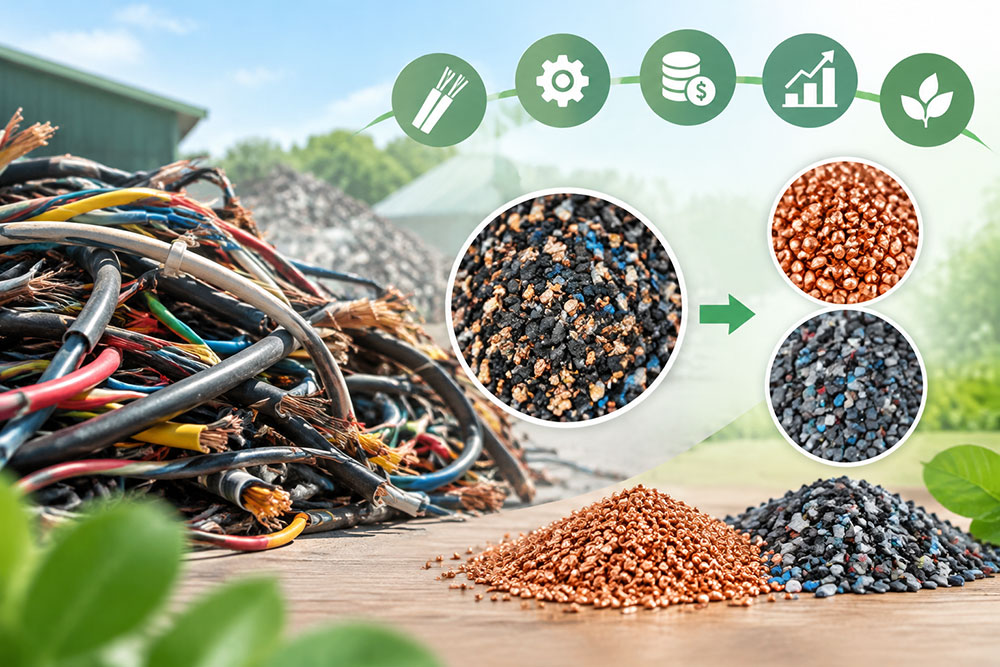
Different types of scrap cables require different processing capabilities from the equipment.
Before making a purchase, it is advisable to provide actual samples of the cables so that the supplier can confirm whether the equipment is capable of processing them effectively.
This is one of the most important factors to consider when choosing a copper wire granulator.
Do not rely solely on the equipment’s rated hourly processing capacity; also take into account daily operating hours, the stability of your raw material supply, and the actual operational efficiency of the equipment.
However, this is just a basic calculation; in practice, you must also account for factors such as equipment downtime, cleaning, and variations in raw material. A machine’s nominal capacity is not the same as its actual capacity, so it is best to include a safety margin when selecting equipment.
The value of a piece of equipment is determined not only by how many kilograms of cable it can process per hour, but also by its copper recovery efficiency, the quality of copper-plastic separation, and its overall operating costs.
When making a selection, it is recommended to focus on the following three aspects:
For instance, equipment that is inexpensive but offers poor separation may necessitate additional manual sorting—ultimately proving more costly in the long run.
The price of the equipment is only one part of the total investment; you must also account for ongoing costs such as electricity, labor, tool wear, and maintenance.
Choose equipment based on the scale of your business—avoid situations where machinery sits idle for long periods, but also be careful not to sacrifice production efficiency just to save on the initial purchase price.
Before making a purchase, it is best to provide the supplier with samples of the cables, your target processing volume, and your daily operating hours; this will ensure more accurate equipment configuration recommendations.
If you are looking for a reliable copper wire recycling solution, please contact Gomine. Our team will help you select the right equipment setup based on your specific raw materials and processing requirements.