Leave Us a Message
Contact us now to get professional waste recycling solutions and quotation!
Shredding is merely the initial stage of scrap recycling; the resulting material is often still a mixture. To boost recovery rates, sorting equipment is essential.
Eddy current separators utilize the electrical conductivity of non-ferrous metals to perform separation, proving highly effective for aluminum, copper, and brass. So, exactly which materials can they sort, and how are they utilized across different sectors of the recycling industry?
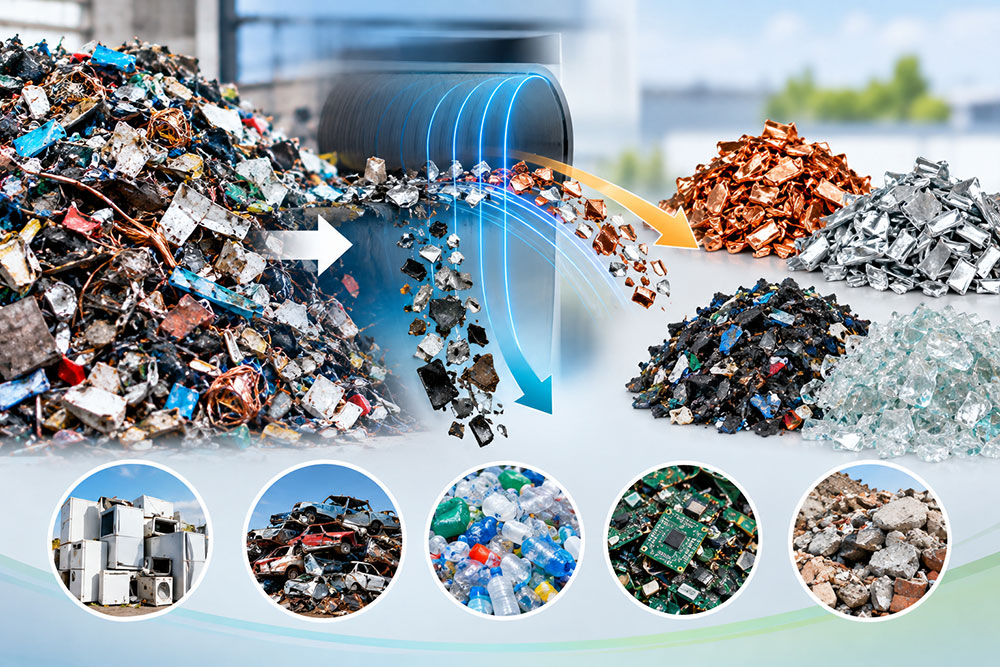
After discarded home appliances—such as refrigerators, washing machines, and air conditioners—are dismantled and shredded, they result in a mixture of materials, including:
On the production line, magnetic separation is typically used first to remove iron, followed by the use of an eddy current separator to extract non-ferrous metals like aluminum and copper.
✅The advantages of this approach are:
It reduces the need for manual labor and simplifies the subsequent recycling of the plastics and metals.
After end-of-life vehicles undergo dismantling and shredding, a large volume of mixed material is produced; in addition to ferrous metals (iron and steel), this mixture contains aluminum, copper, and other non-ferrous metals.
💡The typical processing setup involves:
This combination of equipment separates the different materials step-by-step, offering greater convenience for vehicle dismantling and shredding enterprises.
Some waste plastics are not “pure” upon collection; they may contain metal impurities such as screws, aluminum fragments, or copper wires.
✅The benefits are:
Electronic waste has a complex composition, typically containing plastics, glass, and ferrous metals, as well as non-ferrous metals like copper and aluminum.
After dismantling and shredding, the material is reduced in size and the various constituents become more thoroughly mixed. Eddy current separators are used to further isolate non-ferrous metals and are particularly well-suited for integration with shredders, magnetic separators, and screening equipment.
However, the composition of electronic waste varies significantly; in practice, equipment configurations must be tailored to the specific characteristics of the raw material and the desired recovery objectives.
In addition to household appliances, automobiles, and electronic waste, eddy current separators can also be used for municipal solid waste, construction debris, incinerator bottom ash, and shredded metal scrap.
Generally speaking:
Gomine offers integrated solutions—combining shredding, screening, magnetic separation, and eddy current separation—tailored to the client’s specific raw materials, processing capacity, and recovery requirements. Please feel free to contact us at any time.