Leave Us a Message
Contact us now to get professional waste recycling solutions and quotation!

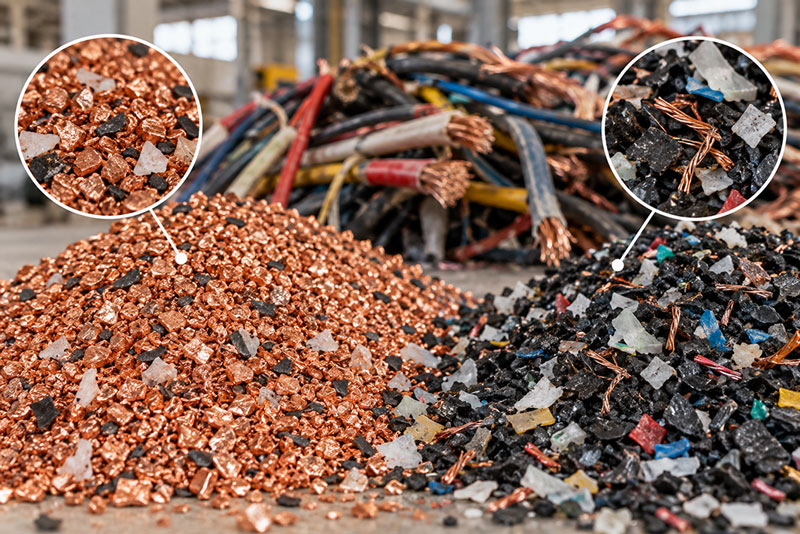
In cable recycling, a copper granulator separates copper from plastic by shredding, crushing, and sorting. Normally, the finished copper granules should be pretty pure.
But in real production, some users run into problems: plastic mixed in with the copper, or copper wire still left in the plastic. This usually isn’t just one machine’s fault — it comes down to a mix of the material being fed in, machine settings, and how well the separation works.
Here are 5 common reasons.
Old cables come in all shapes and sizes — different wire diameters, copper content, and insulation thickness. If you mix really thick and really thin cables together, crushing and separation won’t work as well.
💡For example:
So before feeding material into a waste cable recycling machine, a quick sort by cable type goes a long way. It keeps the whole process running more smoothly.
This one’s easy to overlook.
If the wires aren’t crushed enough, copper can still be stuck to the plastic, so separation won’t be complete. But if you over-crush, both copper and plastic turn into really fine particles — and that makes separation harder too.
✅The sweet spot:
So blade condition, crushing gap, and screen size all need to be adjusted based on the material you’re running.
Separating copper from plastic isn’t just about crushing — it also relies on airflow and vibration sorting.
If the airflow is too strong or too weak, separation suffers. For example, lighter plastic may not get blown away and ends up in the copper. Or fine copper particles get carried off with the plastic.
🌐So in production, you need to adjust settings based on:
Don’t just run the same fixed settings all the time.
If scrap wires sit outside for a long time, they soak up moisture. Too much moisture hurts material flow, makes copper and plastic particles stick together, and messes with airflow separation.
After a copper granulator runs for a while, worn blades, clogged screens, dust buildup in the fan, or material stuck in the conveying path can all hurt separation.
♻️If copper purity suddenly drops, check these first:
Most of the time, timely maintenance and adjustment matter more than replacing the whole machine.
✅Bottom line: different types of scrap wire need the right copper granulator and the right settings. That’s how you get steady copper recovery and clean output.
At Gomine, we focus on cable and metal recycling equipment. We match the copper granulator or full recycling line to your material, capacity, and desired output.